
7 Risky Contract Clauses UK Freelancers Should Always Check

Published on
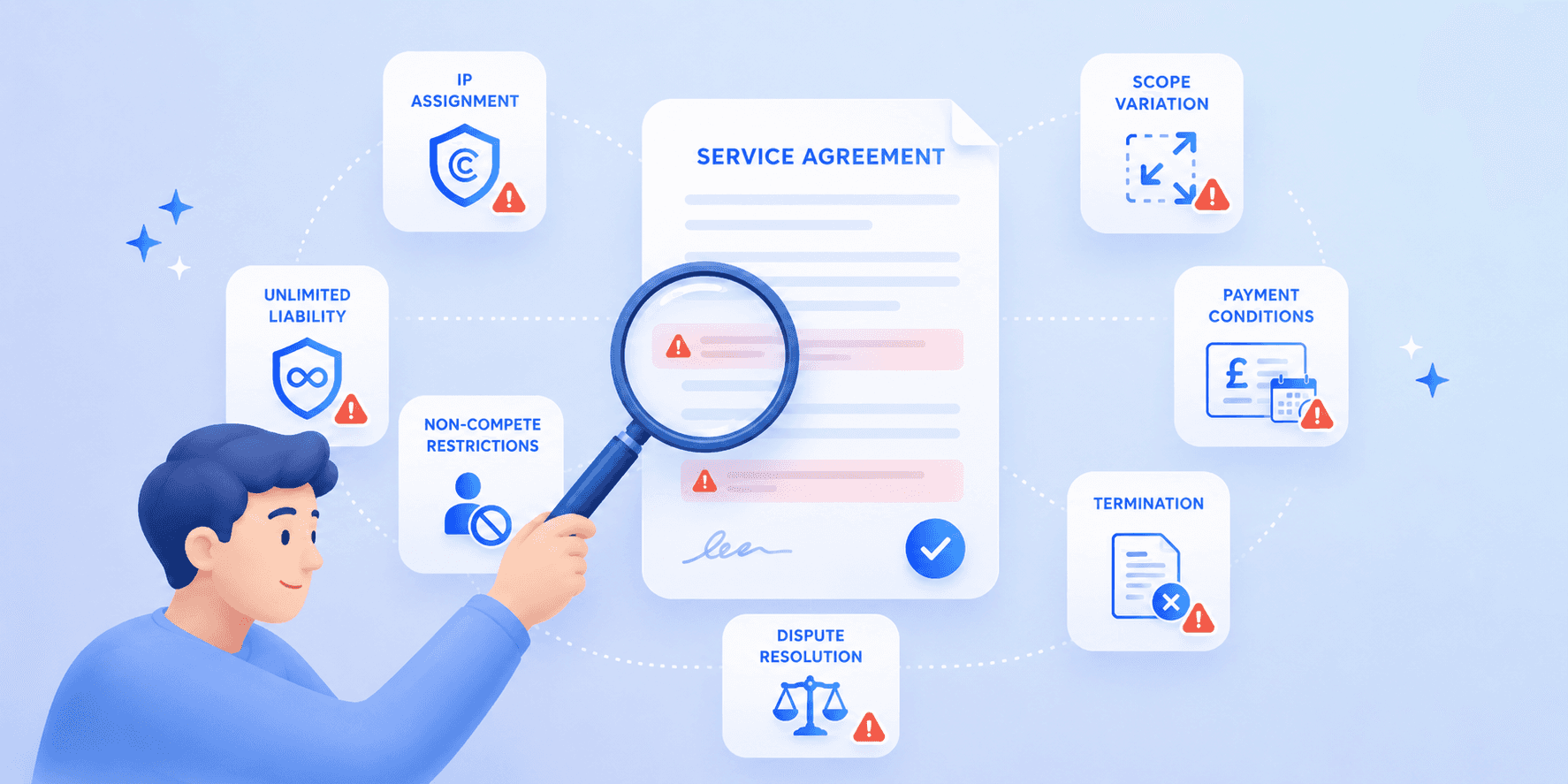
The riskiest clauses in a UK freelance contract are IP assignment, unlimited liability, non-compete restrictions, scope variation, payment conditions, termination provisions, and dispute resolution. Most freelancers sign them without understanding what they've agreed to.
Keira, a freelance UX designer in Edinburgh, spent six weeks on a product redesign for a fintech startup. Her contract included an IP assignment clause (standard-looking wording, easy to miss). When the relationship ended badly, she tried to use samples of the work in her portfolio. The client threatened legal action. She'd signed away every right to work she'd created. Clause 8, paragraph 3, buried on page four. She'd never read it.
Most risky contract clauses don't look risky at first glance. They're written in confident legal language designed to read like standard boilerplate. This guide names the seven most dangerous ones, shows you what the clause actually looks like in practice, and tells you what to do when you find one.
Key Takeaways
IP assignment clauses transfer ownership of your work to the client, often immediately and sometimes without full payment being a condition
Unlimited liability clauses can expose you to claims worth far more than the contract value
Non-compete restrictions can prevent you from taking new clients for months after a project ends
"Satisfactory completion" payment triggers give clients the power to delay or withhold payment indefinitely
Most risky clauses can be negotiated before you sign. The time to act is before, not after
Why certain clauses carry more risk than others
Not all contract clauses are equal. Some are standard boilerplate (governing law provisions, entire agreement clauses, severability wording) and they'll rarely affect you in practice. Others determine whether you get paid, whether you keep ownership of your work, and whether you can take on new clients in your own field for the next 12 months.
Risky clauses share a common feature: they transfer power or exposure from the client to you, often in language that sounds neutral or administrative. "The contractor assigns all intellectual property rights..." reads like legal standard-setting. It is actually the client taking permanent ownership of everything you've built.
The seven clauses below are the ones that consistently cause real problems for UK freelancers. To see how they fit into a complete review, work through our guide to reviewing your whole contract end to end.
1. IP assignment: who owns the work you create?
What to look for: "The contractor hereby assigns to the client all intellectual property rights, including copyright, in the deliverables..."
Under UK law (specifically the Copyright, Designs and Patents Act 1988), freelancers own the copyright in work they create by default. This is the opposite of employment law, where employers own work created in the course of employment. When you freelance, you start from a position of legal ownership.
An IP assignment clause changes that. It transfers ownership of your work to the client, sometimes on delivery, sometimes on payment, and sometimes without payment being a condition at all.
What makes this clause risky isn't just the ownership question. It's the downstream consequences: you cannot put the work in your portfolio without permission, you cannot reuse any elements in future projects, and you lose all negotiating power in a payment dispute because the client already owns what you delivered.
The safer alternative is a licence: you retain copyright and grant the client an exclusive, perpetual licence to use the work. They get everything they need. You keep your rights.
For a deeper look at how IP assignment works and what to push back on, read our guide to IP ownership in your freelance contract.
2. Liability cap: what's your exposure?
What to look for: The absence of any liability cap. Or explicitly: "The contractor's liability shall not be limited in any way..."
Every professional contract should include a clause capping your liability at a reasonable amount, typically the value of the contract. Without one, you're exposed to unlimited claims. A client who suffers a loss and attributes it to your work can, in theory, sue for any amount.
The Unfair Contract Terms Act 1977 provides some protection. Courts can assess whether a liability clause is reasonable, and a clause that is unreasonably broad may be unenforceable. But "may be unenforceable" is not a position you want to test in litigation.
Reasonable liability caps follow this principle: your exposure should be proportional to what you earned. A cap at the total contract value is standard. A cap at two times the contract value is still defensible. Unlimited liability for a £2,000 project is not.
If you see no liability cap in your contract, request one before signing. If the clause explicitly excludes any limitation on your liability, this is a red flag regardless of the contract value.
3. Non-compete and post-project restrictions
What to look for: "The contractor shall not, for a period of 12 months following completion, provide services to any competitor of the client..."
Also known as restrictive covenants, non-compete clauses restrict where you can work after a project ends. In an employment context these are common, and courts scrutinise them carefully. In a freelance context they're considerably more dangerous, because you typically have no notice period, no garden leave, and no compensation for the restriction.
UK courts apply a strict enforceability test: the clause must go no further than necessary to protect a legitimate business interest. Scope, geography, and duration all factor in. A broad clause that bans you from working for "any company in the technology sector" for 12 months is unlikely to be enforceable, but you'd need to go to court to establish that.
The question isn't always whether the clause is enforceable. It's whether you want the threat of litigation hanging over you while you try to take new clients. Even an unenforceable clause is a practical restraint if the client is willing to send letters.
Check the scope carefully: which industries, which clients, and for how long. Anything over six months in duration, or with geographic scope beyond the client's direct market, warrants a conversation before you sign. For the full picture on how these clauses work under UK law, see our guide to non-compete clauses and whether they're enforceable.
4. Scope variation: the unlimited additional work trap
What to look for: "The contractor shall carry out such additional work as the client may reasonably require..."
This clause sounds modest. In practice, it is a mechanism for unpaid work. "Reasonably require" is subjective. Clients and freelancers routinely disagree on what counts as reasonable, and without a defined process for approving and pricing variations, additional requests accumulate without ever being formally agreed or paid for.
The cleaner version of this clause specifies that any variation to scope must be agreed in writing before work begins, and that additional work will be charged at a specified day rate or agreed separately. That's the amendment worth requesting.
💡 Pro Tip: If a client resists a formal change control process, ask them to define "reasonable" in the contract itself. The conversation often surfaces the problem before it becomes one.
5. Payment conditions: the "satisfactory completion" trap
What to look for: Payment triggered by "satisfactory completion", "client acceptance", or "approval of deliverables", rather than by delivery or invoice date.
The Late Payment of Commercial Debts (Interest) Act 1998 sets a statutory default of 30 days for payment between businesses. Most contracts use this as a baseline. The risk isn't usually the payment period. It's the trigger condition.
"Payment within 30 days of invoice" is clean. The clock starts when you send the invoice.
"Payment within 30 days of satisfactory completion" is a problem. The clock doesn't start until the client decides they're satisfied, which they may never formally confirm. This is how payment disputes begin: not with a client who refuses to pay outright, but with a client who refuses to sign off on the work.
Other red flags include: milestone payments that require formal client approval at each stage, hold-back provisions that retain a percentage until a vague condition is met, and payment terms of "30 days from the end of the month the invoice is received," which can effectively extend your wait to 60 days.
For a full breakdown of payment terms and your rights under UK law, read our guide to payment terms and what's standard in UK freelance contracts.
6. Termination: can they cancel without paying you?
What to look for: "Either party may terminate this agreement on seven days' notice..." with no provision for work completed before termination.
Short notice periods and no work-in-progress protection are the combination that leaves freelancers unpaid. If a client can terminate with seven days' notice and the contract is silent on what happens to work you've already completed, you're absorbing that loss.
Dan, a freelance copywriter in Manchester, was engaged on a three-month content retainer. In week six, the client terminated with 48 hours' notice, a right explicitly granted in the contract. He was owed for two weeks of work he'd completed but not yet invoiced. The contract had no work-in-progress provision. He received nothing.
A well-drafted termination clause should include: reasonable notice (14 days minimum for most projects, longer for longer engagements), a provision for payment of all work completed to the termination date, and ideally a kill fee if the client terminates without cause once a project is underway. Check both the notice period and what happens to outstanding work and invoices on termination. Both matter.
7. Governing law and dispute resolution
What to look for: "Each party shall bear its own legal costs in the event of a dispute..." or a mandatory arbitration clause.
The "each party bears their own costs" clause sounds neutral. It's usually not. If a client with a legal team decides to dispute your invoice, you face the cost of defending that dispute, or walking away from what you're owed. The clause eliminates the prospect of recovering your legal costs even if you win, which makes litigation economically irrational for smaller amounts.
Also watch for arbitration clauses that route disputes away from the courts. Arbitration can be faster, but it is typically more expensive to initiate than a small claims court action, which for debts under £10,000 remains an accessible and low-cost route for freelancers in England and Wales.
If a clause specifies that disputes must be resolved through a named arbitration body, check the cost of initiating a claim before signing. Some arbitration schemes charge initiation fees that exceed the amount you're likely to be owed.
What to do once you've spotted a risky clause
Identifying a risky clause is the start of the process, not the end. Once you know what's problematic, you have three options: negotiate it, accept it with a clear understanding of your exposure, or walk away from the contract.
Most of the time, negotiation is the right move. Clients expect some back-and-forth on terms, particularly on IP, liability, and payment conditions, and a professional, well-framed request is rarely a relationship risk. For the exact language to use when raising each of these points, read our guide to how to negotiate your freelance contract terms before signing.
If you'd prefer not to go through the contract alone, Ookulli reviews your contract from £10 and flags every risky clause with a plain-language explanation of what it means and what to push back on.
Frequently asked questions
What are the most common risky clauses in UK freelance contracts?
The most common problematic clauses are IP assignment (which transfers copyright to the client on delivery), unlimited liability (which exposes you to claims beyond the contract value), payment triggers tied to client approval rather than invoice date, and post-project non-compete restrictions. These four appear regularly in client-drafted service agreements across all creative and professional disciplines.
Can I amend a risky clause before signing a freelance contract?
Yes. Any clause in a service agreement can be proposed for amendment before signing. The standard approach is to respond in writing with your proposed changes and request the client's written confirmation. Once both parties confirm the amended terms, the amendment is binding. Never amend a clause unilaterally. Always get written agreement first.
What does it mean when a contract has no liability cap?
No liability cap means your exposure to claims is theoretically unlimited. If the client suffers a loss and claims it results from your work, they can sue for any amount. The Unfair Contract Terms Act 1977 provides some protection, and unreasonably broad liability clauses can be challenged, but the better approach is to negotiate a cap before signing, typically set at the total contract value.
Is an IP assignment clause standard in UK freelance contracts?
IP assignment clauses are common in contracts for creative work (design, writing, software development) but they are not a legal requirement, and their scope is always negotiable. The alternative is a licence: you retain copyright and grant the client an exclusive right to use the work. For most clients, a well-drafted licence gives them everything they actually need.
How long can a non-compete clause last in a UK freelance contract?
There is no fixed legal maximum, but UK courts apply a reasonableness test. Non-compete clauses in freelance contracts that exceed six months in duration, cover entire industry sectors, or have no geographic limit are more likely to be challenged successfully as unenforceable. The key factors are scope, duration, geography, and whether the restriction goes further than necessary to protect a legitimate business interest.
What is the "satisfactory completion" payment trap?
It's a payment trigger that ties when your invoice clock starts to the client's formal sign-off on the work, rather than to delivery or invoice date. Because "satisfactory" is subjective and undefined, a client can delay sign-off indefinitely without technically breaching the contract. The fix is to negotiate payment triggers tied to delivery or invoice date, not to approval.
This article is for informational purposes only and does not constitute legal advice. If you have specific concerns about your contract, consider consulting a qualified solicitor.