
Non-Compete Clauses in Freelance Contracts: Are They Enforceable in the UK?

Published on
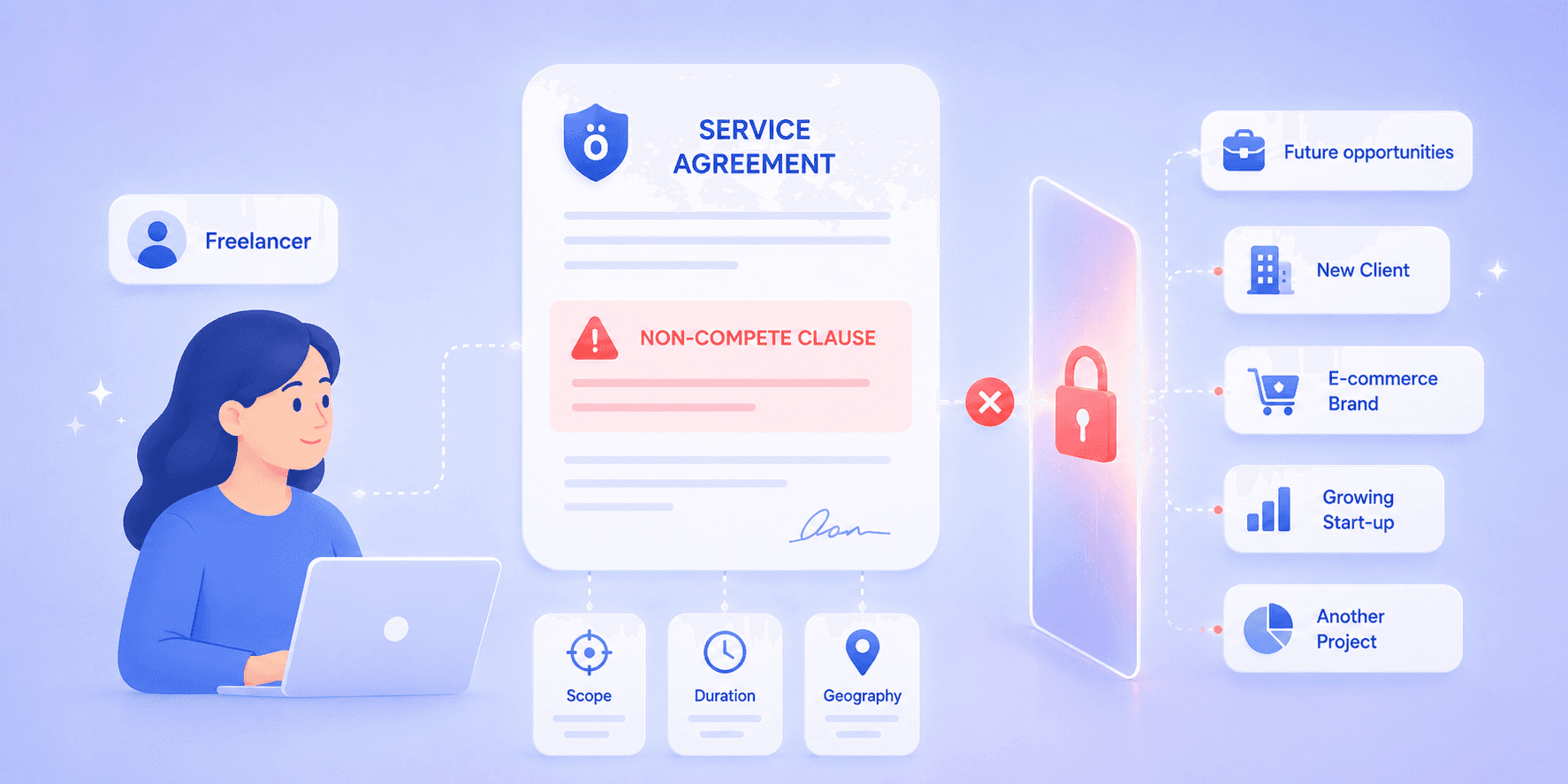
Non-compete clauses in UK freelance contracts are enforceable only if they're reasonable in scope, duration, and geography, and if they protect a legitimate business interest. Clauses that are too broad, too long, or apply to industries beyond the client's actual market are likely to fail the enforceability test. But "likely unenforceable" is not the same as "safe to ignore."
This guide explains how UK courts assess non-compete clauses in freelance contracts, what makes a clause reasonable versus void, and how to push back before you sign. That's far easier than challenging one after the fact.
Key Takeaways
UK courts apply a reasonableness test: non-competes must protect a legitimate interest and go no further than necessary
Freelance non-competes are held to a stricter standard than employment non-competes because freelancers have less bargaining power and receive no equivalent of garden leave
Scope, duration, and geography all matter: a clause that fails on any one of these dimensions may be void
Courts will not rewrite a clause to save it, but they can sever the unenforceable words if the "blue pencil" test from Tillman is met. A clause that fails the test entirely can take more of the contract down with it.
Even an unenforceable clause can cost you money to challenge. The time to act is before you sign
What is a non-compete clause in a freelance contract?
A non-compete clause (also called a restrictive covenant or post-project restriction) is a provision that limits who you can work for, and what work you can take on, after a project with a particular client ends.
You'll usually find these clauses near the end of a service agreement, under headings like "Restrictions," "Restrictive Covenants," or "Post-Termination Obligations." Common variations include:
Non-compete: You cannot provide services to companies competing with the client
Non-solicitation: You cannot approach the client's customers, suppliers, or employees
Non-dealing: You cannot work with the client's contacts even if they approach you first
These clauses often appear together. A contract might restrict you from competing, approaching existing client contacts, and dealing with anyone introduced to you during the project, all simultaneously. Restrictions are one of six key areas in our start-to-finish freelance contract review guide.
Priya, a freelance digital marketer in Birmingham, signed a service agreement with an e-commerce agency. The contract included a 12-month non-compete covering "all e-commerce businesses in the UK." She didn't read it carefully before signing. Three months later, the agency ended the engagement. She spent the next year turning down the majority of her inbound work, not because the clause was enforceable, but because she couldn't afford to test whether it was.
Are non-compete clauses enforceable for freelancers in the UK?
The short answer is: sometimes. UK courts apply a reasonableness test based on common law principles developed over decades of employment and commercial law. The leading modern case, Tillman v Egon Zehnder [2019] UKSC 32, confirmed that courts will not rewrite a clause to save it. If it's drafted too broadly, the clause falls.
For a clause to be enforceable, it must:
Protect a legitimate business interest: client relationships, trade secrets, or specialist knowledge the client shared with you are examples; a general desire to prevent competition is not
Go no further than reasonably necessary: the restriction must be proportionate to the interest being protected
Be reasonable in duration, scope, and geography: each dimension is assessed independently
Freelancers are treated more strictly than employees in some respects, and with more flexibility in others. Unlike an employee, a freelancer typically has no garden leave, no notice period pay, and no enhanced package in exchange for the restriction. Courts consider this when assessing reasonableness. A clause that might be acceptable in an employment context can fail when applied to a self-employed contractor who receives nothing in return for agreeing to it.
What makes a non-compete clause reasonable versus void?
The difference comes down to specificity. Courts consistently find that restrictions framed around the client's actual business (their named competitors, specific customer segments, or a defined geographic market) are more likely to survive challenge than restrictions that cover entire industry sectors or global markets.
Factor | More likely enforceable | More likely void |
|---|---|---|
Scope | Named competitor or defined client category | "Any business in the technology sector" |
Duration | Three to six months | 12 months or more without justification |
Geography | Client's specific operating region | UK-wide or global without justification |
Activity | Your specific service specialism as delivered | "Any similar professional services" |
A clause restricting you from working for two named direct competitors of your client for three months after a project ends is far more likely to be enforceable than one preventing you from providing "any marketing services" to any business "anywhere in the world" for 12 months.
The court's question is: what legitimate interest is this protecting, and is this restriction proportionate to protecting it? If the answer to either part is unclear, the clause is at risk.
💡 Pro Tip: If a non-compete clause covers your entire specialism rather than the client's specific business, it's doing more than protecting a legitimate interest. It's restricting your ability to earn. That is the sign of a clause that warrants a push-back before signing.
Non-solicitation and non-dealing clauses: often stricter
Non-solicitation clauses are frequently more enforceable than broad non-competes because they're more specific: they restrict your ability to approach people you were introduced to through the client, rather than banning you from an entire market.
A clause preventing you from approaching the client's named customers for six months after a project has a defined scope and a plausible legitimate interest: protecting the client's existing relationships. Courts are more comfortable enforcing this kind of restriction.
Non-dealing clauses go further: they prevent you from working with the client's contacts even if those contacts approach you. These are harder to justify for freelancers and warrant closer scrutiny. If a former client's customer gets in touch with you independently, months after a project ends, a non-dealing clause could prevent you from taking that work, for a contact you didn't solicit.
Both of these clauses can appear in the same agreement as a non-compete. Read all three carefully. For a broader picture of where non-competes sit alongside other risky clauses, see our guide to risky clauses in UK freelance contracts.
How to negotiate a non-compete clause before signing
Most non-compete clauses in client-drafted service agreements are copied from employment contract templates and applied to freelance arrangements without adjustment. This means they're frequently drafted more broadly than the client actually needs, and more broadly than any court would enforce.
The three amendments worth requesting:
1. Limit the scope to named competitors
Instead of "any business in the same sector," request that the clause names the specific competitors the client legitimately needs to protect against. If they can't name them, the clause is broader than necessary.
2. Reduce the duration
Three months is a defensible starting position for most freelance engagements. Six months is reasonable for high-value, specialist work where you had access to sensitive strategic information. Twelve months is rarely justified for a standard service contract.
3. Add geographic limits if your market is regional
If your client operates in a specific city or region and you work locally, request that the restriction mirrors their actual market. A UK-wide restriction for a client with a regional business is disproportionate.
David, a freelance web developer in Edinburgh, received a service agreement with a 12-month, UK-wide non-compete covering "all digital services." He requested three changes in a single email: limit the clause to named competitors (the client had two), reduce the duration to three months, and limit geography to Scotland. All three were agreed in the client's next response. The clause still existed, but it was proportionate.
For the exact language to use when raising these amendments professionally, read our guide on how to negotiate your freelance contract terms before signing.
What to do if your non-compete clause seems too broad
If you've already signed a contract with a broad non-compete, or a client is threatening to enforce one, your options are:
1. Assess the clause against the reasonableness test
Work through scope, duration, and geography. Does the clause protect a legitimate interest? Is it proportionate? If it fails the test on any dimension, it may be wholly or partially unenforceable.
2. Seek a waiver from the client
Before taking conflicting work, contact the former client and ask whether they'd agree to waive the restriction in the specific circumstances. A professional, specific request is often granted, especially if the client has no practical interest in enforcing it for your particular situation.
3. Get legal advice before acting
If the clause is broad and the client has indicated they intend to enforce it, consult a solicitor before taking any potentially conflicting work. The cost of a brief legal consultation is less than the cost of a contested injunction.
The key point: "probably unenforceable" is a legal argument, not a safe harbour. A client with a legal team can still issue a letter, apply for an interim injunction, and create significant practical disruption even if the clause would ultimately fail at trial. Acting on the assumption that a clause is void, without taking advice, is a risk.
How to check what restrictions your contract actually contains
Non-compete clauses are sometimes clearly labelled. More often, they're embedded in a section headed "Restrictions" or "Obligations," alongside non-solicitation and non-dealing provisions. In some NDAs, restrictive covenants appear as a separate embedded clause. See our guide to reviewing an NDA in the UK for what to look for there specifically. If that's your situation, check whether an NDA can stop you working for competitors.
Check what restrictions your contract includes with Ookulli from £10. Ookulli flags non-compete, non-solicitation, and non-dealing clauses in plain language, identifies whether the duration and scope are within the range UK courts typically accept, and explains what amendments to request.
Frequently asked questions
Are non-compete clauses in freelance contracts legal in the UK?
Yes. Non-compete clauses are legal in UK freelance contracts. Whether they're enforceable is a separate question that depends on their reasonableness. A clause that is unreasonably broad in scope, duration, or geography may be void, but it's not illegal to include one.
How long can a non-compete clause last in a UK freelance contract?
There's no fixed statutory maximum. Courts assess duration as part of the overall reasonableness test. For most freelance engagements, three to six months is the range where courts are most comfortable. Twelve-month clauses are frequently challenged and often found disproportionate, particularly where the freelancer received no consideration specifically for the restriction.
What is the difference between a non-compete and a non-solicitation clause?
A non-compete prevents you from working for competitors of the client, broadly defined. A non-solicitation clause prevents you from approaching the client's specific contacts (customers, employees, or suppliers) after the project ends. Both may appear in the same contract. Non-solicitation clauses are often more narrowly drafted and therefore more likely to be enforceable.
Can a client enforce a non-compete if I was only engaged for a short project?
Yes, in theory. The enforceability doesn't depend on the project length; it depends on whether the clause is reasonable in the specific circumstances. A three-month non-compete on a one-week project may be harder to justify than the same clause on a six-month engagement, because the client's exposure from a brief relationship is more limited. Courts consider the totality of the arrangement.
What happens if I breach a non-compete clause in my freelance contract?
The client can apply for an injunction (a court order preventing you from continuing the conflicting work) and claim damages for any loss caused by the breach. Injunctions can be obtained quickly (sometimes within days), which is why a clause that might ultimately fail at trial can still cause immediate, serious disruption if a client is willing to litigate.
Can I negotiate a non-compete clause after I've already signed?
Yes. You can request an amendment at any point, including after signing. Both parties need to agree to the change in writing. A new agreement (technically a deed of variation or simply a written amendment) is needed to amend a signed contract. The client isn't obliged to agree, but many will accept reasonable changes, especially if the engagement is ongoing and the relationship matters to them.
This article is for informational purposes only and does not constitute legal advice. If you have specific concerns about a non-compete clause in your contract, consider consulting a qualified solicitor.