
How long does an NDA last in the UK?

Published on
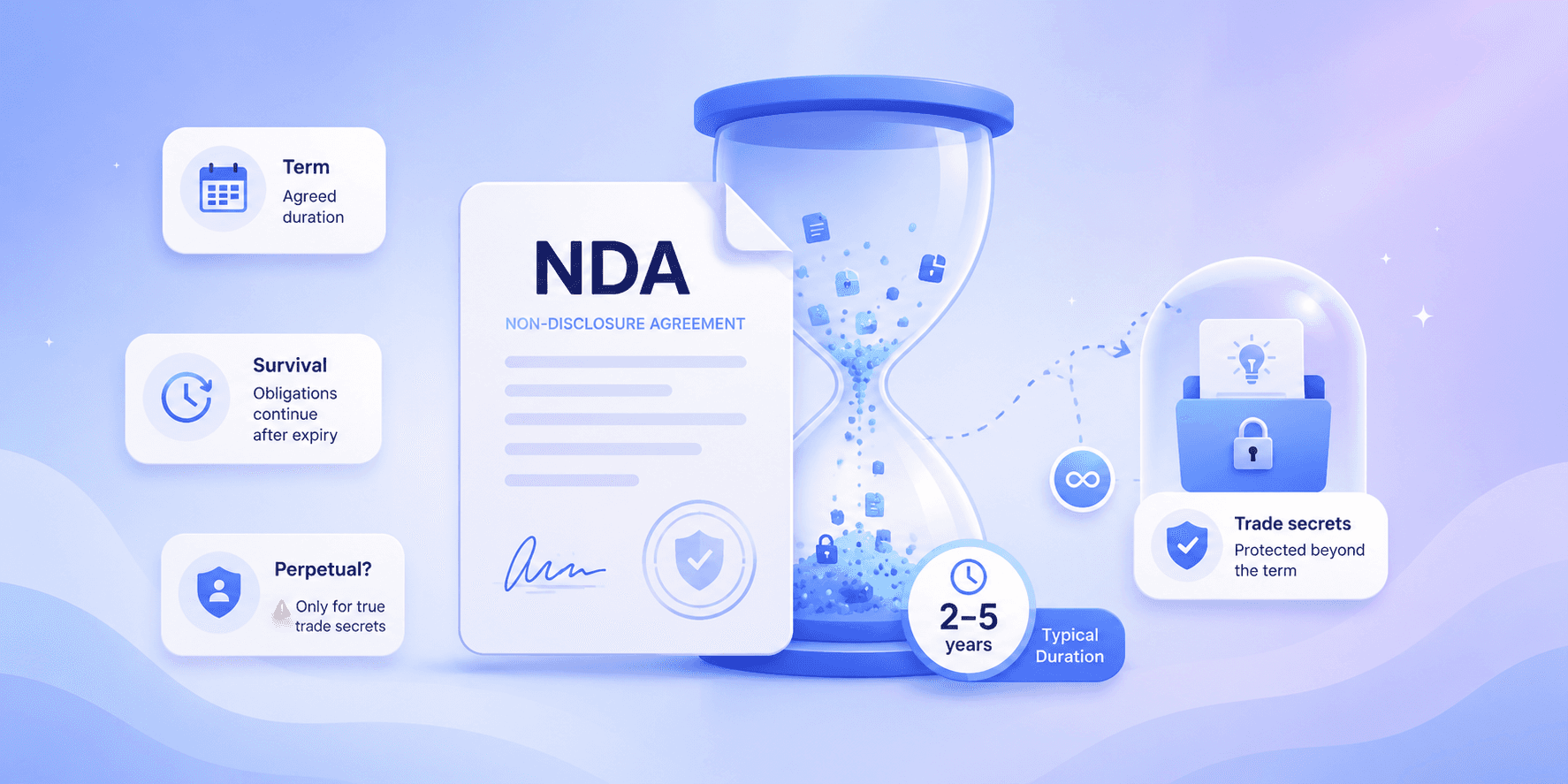
There is no fixed legal maximum for how long an NDA can last in the UK. In practice, confidentiality obligations commonly run for 2 to 5 years from disclosure, and that is what most freelancers should expect to see. The exception is genuine trade secrets, which can be protected indefinitely. An NDA that demands perpetual confidentiality over ordinary project information is not illegal, but it is unreasonable, and it is one of the most common things worth pushing back on before you sign.
Here is what actually determines an NDA's duration, what counts as reasonable, and when an open-ended term is a red flag.
Key Takeaways
UK law sets no maximum NDA duration; 2 to 5 years is the commercial norm for ordinary business information
Two clauses control how long you are bound: the term clause (how long the agreement runs) and the survival clause (how long confidentiality continues after the agreement ends)
Genuine trade secrets can justify indefinite protection; a project brief, a client list snapshot or a product roadmap usually cannot
"Perpetual" or missing duration language in a freelancer NDA is a negotiation point, not something to accept silently
A reasonable ask: cap confidentiality at 3 years except for defined trade secrets
The two clauses that set an NDA's duration
People look for one number in an NDA. There are usually two.
The term clause says how long the agreement itself runs: "This agreement commences on the date of signature and continues for a period of two years." That is the window during which disclosures are covered.
The survival clause says how long the confidentiality obligations continue after the agreement ends: "The obligations of confidentiality shall survive termination of this agreement for a period of three years." This is the one that actually binds you into the future.
The combination is what matters. A one-year agreement with five-year survival binds you for six years from an early disclosure. If either clause is missing or says "indefinitely", the document needs a closer look before you sign. If you are not sure which clauses your NDA actually contains, our guide to reviewing an NDA walks through the full checklist, or upload it to Ookulli and see the term and survival clauses flagged and explained in minutes.
What is typical and reasonable in the UK
The honest answer to "how long should an NDA last?" is: as long as the information stays commercially sensitive, and no longer. Commercial practice has settled into rough bands:
1 to 2 years: fast-moving commercial information, such as pricing, marketing plans and pipeline discussions that will be stale within a year anyway
2 to 3 years: the standard band for most freelance project NDAs, covering business plans, internal processes and unreleased product details
5 years: the cautious end, common in financial services, manufacturing and M&A contexts
Indefinite: legitimate only for genuine trade secrets and, in some cases, personal data
For a typical freelance engagement, a 2 or 3 year obligation is reasonable. A 5 year term is worth questioning if the project is a website build or a marketing campaign whose details will be public or worthless long before then.
Maya, a freelance brand strategist in Leeds, was sent an NDA in 2026 with a 10 year survival clause for a six-week rebrand project. She asked one question: which of the materials she would see could still be sensitive in 2036? The client could not name any, and the term came down to three years in the next draft. The number in the template was not a strategy; it was just the biggest number anyone had ever typed into it.
When indefinite confidentiality is justified, and when it is a red flag
UK law does recognise information that deserves open-ended protection. Trade secrets are protected by the law of confidence, reinforced by the Trade Secrets (Enforcement, etc.) Regulations 2018: genuinely secret information, commercially valuable because it is secret, kept secret by reasonable steps. Think manufacturing processes, proprietary algorithms, the recipe.
A trade secret stops being protected when it stops being secret, not when a clock runs out. So an NDA saying "trade secrets remain confidential for as long as they remain trade secrets" is fair drafting.
The red flag is when that indefinite language is applied to everything. "All information disclosed by the company, in perpetuity" turns a confidentiality agreement into a lifetime compliance burden for a project that lasted a month. No NDA, of any duration, can stop you reporting wrongdoing to regulators or the police. The government's NDA guidance says so, and since October 2025 the Victims and Prisoners Act 2024 voids any clause that would stop a victim of crime reporting it. Perpetual drafting that implies total silence is doubly suspect.
The reasonable structure to ask for: ordinary confidential information capped at 2 to 3 years; a separate, narrowly defined trade-secrets category protected for as long as those items remain genuinely secret.
Duration and restrictive covenants are different clocks
One common confusion: the NDA's duration is not the same as the duration of any non-compete or non-solicit restrictions that may be hiding inside it.
Confidentiality for 5 years can be perfectly reasonable. A clause stopping you working for the client's competitors for 5 years almost certainly is not; UK courts assess restrictive covenants on their own reasonableness test, and long restrictions on a freelancer's ability to work are routinely unenforceable. If your NDA mixes the two, treat them separately: accept a sensible confidentiality term, and challenge the work restriction on its own terms. We cover that fight in can an NDA stop you working for competitors in the UK?
What to push back on, and how to say it
If the duration terms are wrong, the fix is usually one email. Be specific, propose wording, stay warm:
"One adjustment before I sign: the confidentiality term is currently indefinite for all information. Could we cap it at three years from disclosure, with trade secrets (as defined in the agreement) protected for as long as they remain secret? Happy to sign today with that change."
That ask is so standard that refusing it tells you something about the client. For the full playbook on what else to check and how to ask, see how to negotiate an NDA in the UK, and if the NDA arrived stapled to a service agreement, the freelancer's guide to reviewing any contract covers the rest of the document.
Not sure if your NDA's duration is reasonable for what you'll actually see? Ookulli reviews your NDA — first contract free, then £10 per document: every clause flagged, the term and survival periods explained, and the specific UK law behind each flag. No subscription, no AI training on your documents, and a 30-day money-back guarantee.
FAQ
Do NDAs expire?
Yes, unless they are drafted not to. Most UK NDAs end when their stated term and survival period run out, commonly 2 to 5 years. Obligations over genuine trade secrets can continue indefinitely, for as long as the information remains secret. If your NDA has no stated duration, the position is uncertain: a court would generally treat confidentiality as lasting only while the information stays secret, not forever. That ambiguity is worth fixing before you sign.
Can an NDA last forever in the UK?
It can, and for genuine trade secrets that is legitimate. For ordinary business information, perpetual confidentiality is commercially unreasonable and a standard negotiation point. UK courts are also less likely to enforce obligations over information that has lost any confidential quality, however long the clause claims to run.
Is a 5-year NDA normal?
It is at the cautious end of normal. Five-year terms are common in financial, manufacturing and acquisition contexts. For a typical freelance project, 2 to 3 years is more proportionate, and it is reasonable to ask for that.
What happens when an NDA expires?
Your contractual confidentiality obligations end, and you can no longer be sued under the agreement for disclosures made after expiry. Two caveats: information that qualifies as a trade secret may still be protected by law regardless of the contract, and disclosures you made while the NDA was in force can still be actionable. Expiry is not retroactive permission.
Informational purposes only, not legal advice. For your situation, consult a qualified solicitor.